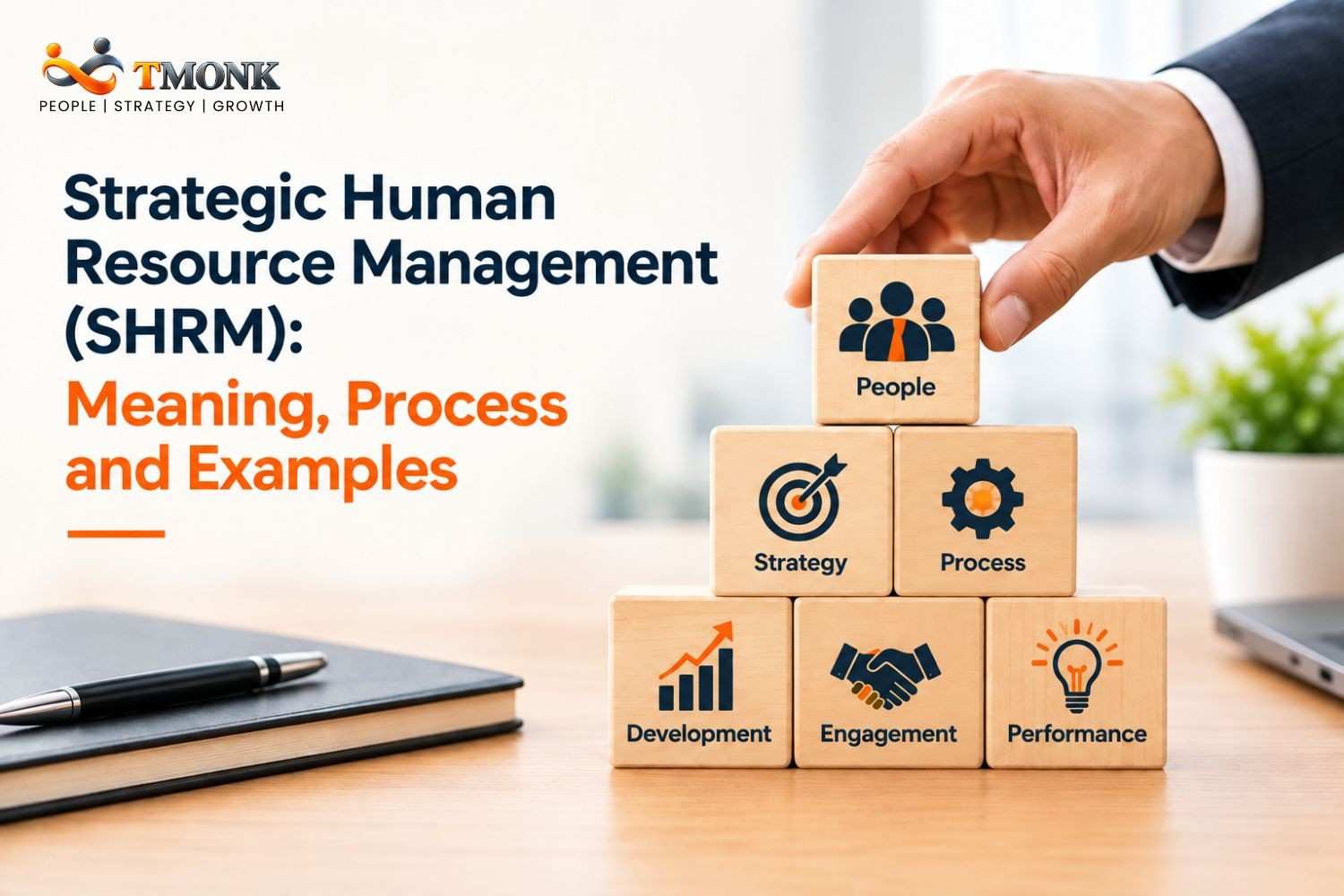
Strategic human resource management (SHRM) is the practice of aligning how a company hires, develops, rewards and retains people with its long-term business goals. Instead of treating HR as administration, SHRM treats the workforce as the main source of competitive advantage and plans it three to five years ahead.
For Indian companies this is no longer optional. Leadership demand is spreading to Tier II cities, GCCs are expanding and skills are scarce. This guide explains what strategic HRM means, how it differs from traditional HRM, the main models, and a seven-step process you can apply, with or without a strategic HR advisory partner
What is Strategic Human Resource Management?
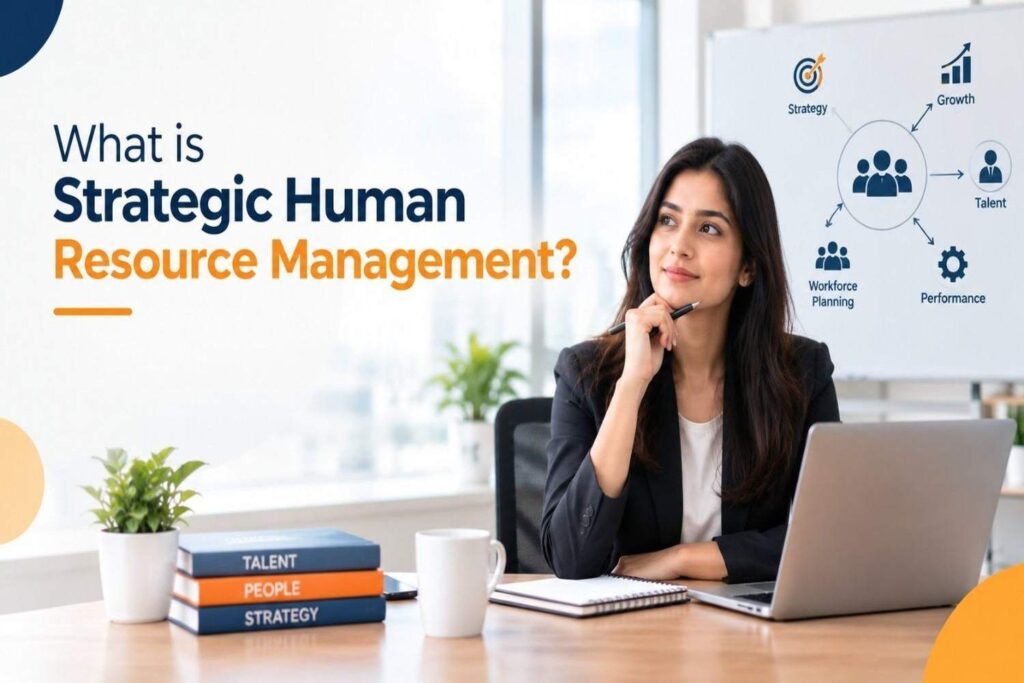
Strategic human resource management is a long-term, business-first approach to people decisions. Every HR policy is designed to support a specific business outcome, such as entering a new market, improving margins or building a leadership pipeline.
Key features of strategic human resource management:
- Aligned with business strategy: HR goals are derived from the company’s growth plan, not set separately.
- Long-term: it plans workforce needs over three to five years.
- Proactive: it anticipates skill and leadership gaps before they hurt delivery.
- Integrated: hiring, performance, rewards and learning work as one system.
- Measured: it tracks business metrics such as revenue per employee, not just HR activity.
- Owned by leadership: the CHRO sits in strategy discussions with the CEO and CFO.
Difference between HRM and SHRM
Traditional HRM runs HR processes efficiently; SHRM decides which people capabilities the business needs and builds them.
Basis | Traditional HRM | Strategic HRM |
|---|---|---|
Focus | Administration and compliance | Business outcomes |
Time horizon | Short term, month to year | Long term, 3–5 years |
Approach | Reactive: fills vacancies as they arise | Proactive: plans workforce ahead |
Role of HR | Support function | Strategic partner to the CEO |
Decision basis | Policies and precedent | Data and business strategy |
View of employees | Cost to control | Asset to invest in |
Key metrics | Time to hire, payroll accuracy | Revenue per employee, leadership bench strength |
Accountability | HR department | CEO, CHRO and line managers together |
Objectives of Strategic Human Resource Management
The objective of SHRM is to make sure the company has the right people, skills and culture to execute its strategy.
- Align workforce plans with business goals.
- Build a pipeline of future leaders.
- Attract and retain critical talent.
- Raise productivity and performance.
- Develop skills ahead of market shifts such as AI adoption.
- Shape a culture that supports the strategy.
- Manage people costs and compliance risk.
Importance of Strategic Human Resource Management
- Better execution: strategy fails most often for lack of the right people, not the right plan.
- Lower attrition cost: planned careers and rewards reduce regretted exits.
- Faster scaling: workforce plans are ready before expansion starts.
- Stronger leadership bench: fewer emergency external hires at CXO level.
- Credible HR: people decisions are backed by data the board can read.
Strategic Human Resource Management Models
Five models explain most SHRM practice. Use them as lenses, not as rival camps.
Model | Origin | Core idea | Use it when |
|---|---|---|---|
Harvard model | Beer et al., 1984 | Balance stakeholder interests to build commitment, competence, congruence and cost-effectiveness | You need employee buy-in for long-term change |
Michigan (matching) model | Fombrun, Tichy and Devanna, 1984 | HR systems must tightly match business strategy; selection, appraisal, rewards and development form one cycle | Performance and cost discipline come first |
Best-fit (contingency) | Schuler and Jackson, 1987 | HR practices should fit the competitive strategy: cost, quality or innovation | Business units compete in different ways |
Best-practice | Pfeffer, 1998 | A set of high-commitment practices lifts performance in any firm | You are building HR foundations |
Resource-based view | Barney, 1991 | People and culture that are rare and hard to copy create lasting advantage | Talent is your main differentiator |
Strategic Human Resource Management Process (7 steps)
The SHRM process moves from business strategy to workforce plan to measurement, and repeats every year.
- Read the business strategy. List the three or four goals for the next three years, such as new markets, products or margins.
- Audit the current workforce. Map headcount, skills, performance, attrition and cost. This is the base for strategic human resource planning.
- Forecast and find the gaps. Compare the skills and leaders you need with those you have. Decide what to build, buy or borrow, and set a talent acquisition strategy. For CXO gaps, compare the best executive search firms in India.
- Design the HR strategy. Set priorities for hiring, rewards, learning and culture, backed by leadership assessment of the current team.
- Plan leadership continuity. Name successors for every critical role through succession planning.
- Implement through line managers. Translate strategy into goals, budgets and employee performance management cycles.
- Measure and adjust. Review metrics each quarter and reset the plan each year.
Why SHRM Matters in India — 2026 data
Indian companies face a leadership and skills squeeze that only long-term workforce planning solves.
Data point | Figure | Source |
|---|---|---|
CXO and senior leadership moves in India, FY2025–26 | 4,361 | Sapphire Human Capital CXO Moves Report |
Movers who had spent only 1–3 years in their previous role | 48% | Sapphire Human Capital |
CXO moves in Tier II cities | 632 | Sapphire Human Capital |
HR professionals who find judgment and problem-solving skills hardest to hire | 80% | SHRM 2026 Talent Trends (2,000+ respondents, global) |
Senior management hiring growth in India, 2025 | +39% YoY | foundit Insights Tracker |
Expected rise in GCC leadership roles, 2026 | 40% | Industry estimate (ANSR, Xpheno) in press coverage |
Short leadership tenures and scarce skills mean reactive hiring is expensive. Companies that plan succession and skills early hire less often in a hurry.
Strategic Human Resource Management Examples
- Manufacturer entering EVs: forecasts battery and software skills two years ahead, reskills 30% of engineers and hires only the niche roles.
- Family business professionalising: defines CXO roles, runs leadership assessment on family and non-family managers, and uses executive search for a first outside CEO.
- GCC scaling in India: builds a leadership bench in Bengaluru and Hyderabad, with rewards tied to global product ownership.
- NBFC expanding to Tier II cities: creates a branch-manager academy and a regional pay structure before opening branches.
Editor note: these four are illustrative scenarios. Replace at least two with named T Monk client stories or public company cases before publishing.
Challenges of Strategic Human Resource Management
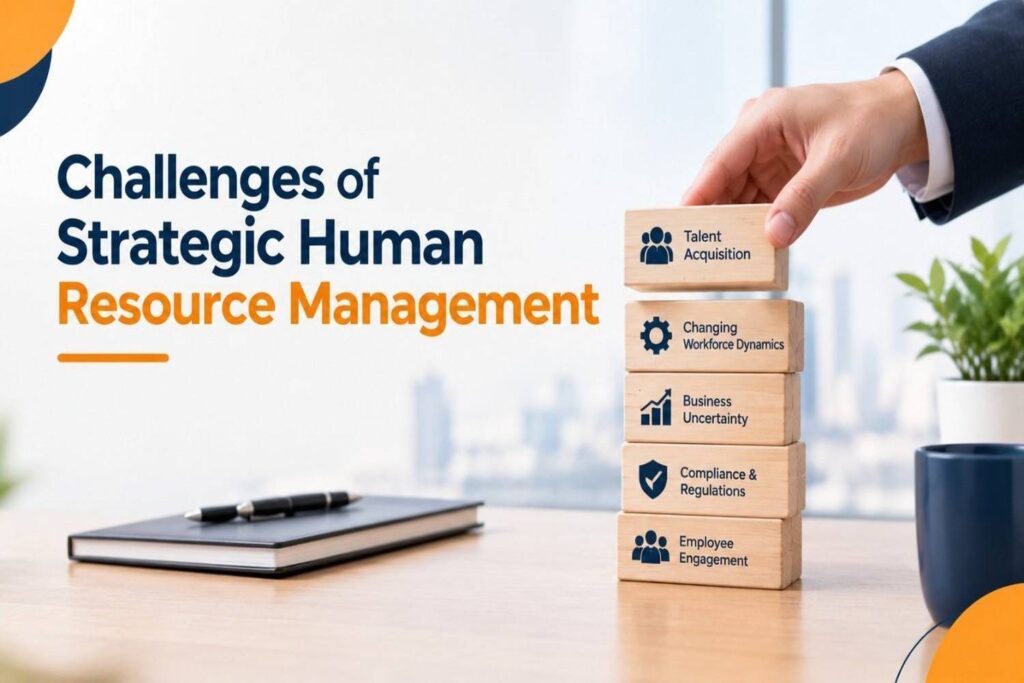
Challenges of strategic human resource management
Challenge | What it looks like | Fix |
|---|---|---|
HR not in strategy talks | Workforce plan is written after the business plan | CHRO joins annual planning from day one |
Poor people data | Headcount and skills sit in spreadsheets | Invest in HR digitization and compliance first |
Short-term pressure | Quarterly targets crowd out capability building | Ring-fence budget for two or three long-term bets |
Line manager resistance | Managers see SHRM as an HR project | Put people metrics in managers’ own goals |
Skills changing fast | Role definitions go stale within a year | Review the skills forecast every six months |
Family or promoter control | Key roles filled by relationship, not readiness | Independent assessment and a written succession plan |
How to Measure Strategic HRM
Track six to eight metrics that a CEO would recognise as business numbers.
- Revenue per employee
- Regretted attrition in critical roles
- Share of critical roles with a ready successor
- Internal fill rate for leadership roles
- Time to productivity for new hires
- Quality of hire at 12 months
- People cost as a percentage of revenue
- Engagement score in high-impact teams
FAQs on Strategic Human Resource Management
What is strategic human resource management in simple words?
It means planning and managing people so that they help the company reach its long-term goals. HR decisions follow the business strategy.
What is the difference between HRM and SHRM?
HRM focuses on day-to-day administration such as hiring, payroll and compliance. SHRM is long-term and links every people decision to business outcomes.
What are the main objectives of SHRM?
Aligning the workforce with strategy, building future leaders, retaining critical talent, raising productivity and shaping culture.
What are the steps in the strategic HRM process?
Read the business strategy, audit the workforce, forecast gaps, design the HR strategy, plan succession, implement through managers, and measure results.
Which are the main models of strategic HRM?
The Harvard model, the Michigan matching model, best-fit, best-practice and the resource-based view.
Is strategic HRM only for large companies?
No. A 100-person firm benefits as soon as it plans growth beyond one year. The process is the same; the tooling is lighter.
Who is responsible for strategic HRM?
The CEO and CHRO own it together, and line managers carry it out. In companies without a CHRO, an external HR advisor often runs the first cycle.
How long does it take to implement SHRM?
A first workforce plan takes 8 to 12 weeks. Visible results in attrition and internal promotions usually take 12 to 18 months.
Build your people strategy with T Monk
Strategic human resource management works when the workforce plan is written alongside the business plan and reviewed like one. If you want an outside view on your leadership bench, succession gaps or HR operating model, speak to a T Monk HR advisor.